Nobody Knows. Here Is Our Best Guess.
Nobody knows for certain. The tapestry does not name its creator, its patron, or its makers. What follows is a reconstruction from internal clues, artistic comparisons, documentary evidence and scholarly argument. Some conclusions are much stronger than others: English manufacture has substantial support, Canterbury is a serious possibility, and Bishop Odo remains one of the leading candidates for patronage. None of those points is proven by a surviving commission or contemporary record.
How strong is the evidence?
The embroidery is very likely to have been made in England.
Canterbury, including links with St Augustine's, fits several artistic and manuscript clues.
Odo may have commissioned it, but prominence in the Tapestry is not the same as documentary proof.
The Patron: Bishop Odo of Bayeux?
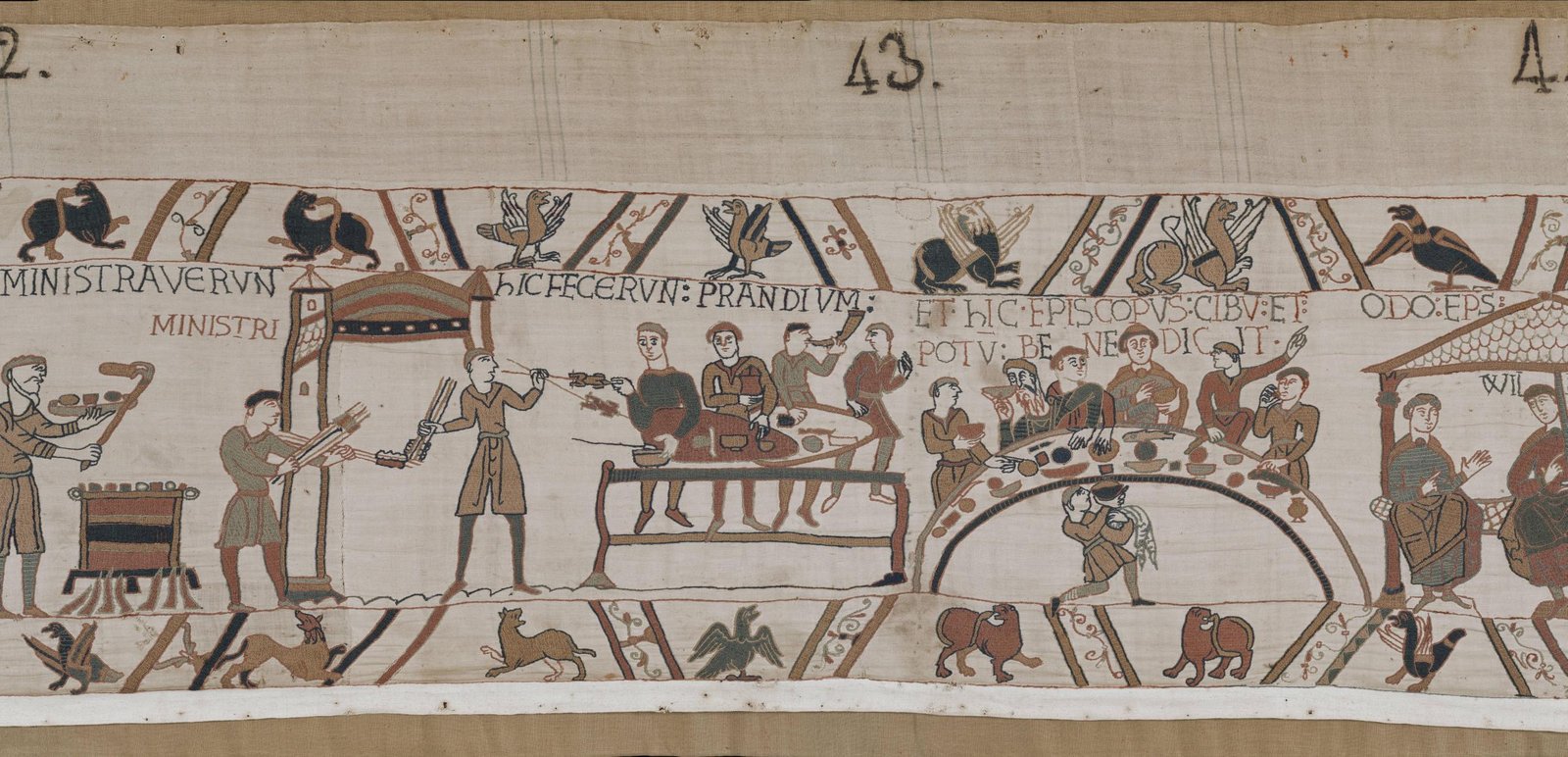
Odo, Bishop of Bayeux and half-brother of William the Conqueror, is one of the leading candidates for the person who commissioned the Tapestry. The case is mostly internal rather than documentary. Odo is given unusual prominence: he appears in the pre-battle feast and is shown rallying Norman troops during the crisis of the battle. The feast composition has often been compared with images of the Last Supper, which may strengthen the impression that Odo was being deliberately honoured. Even so, prominence alone cannot identify the patron with certainty.
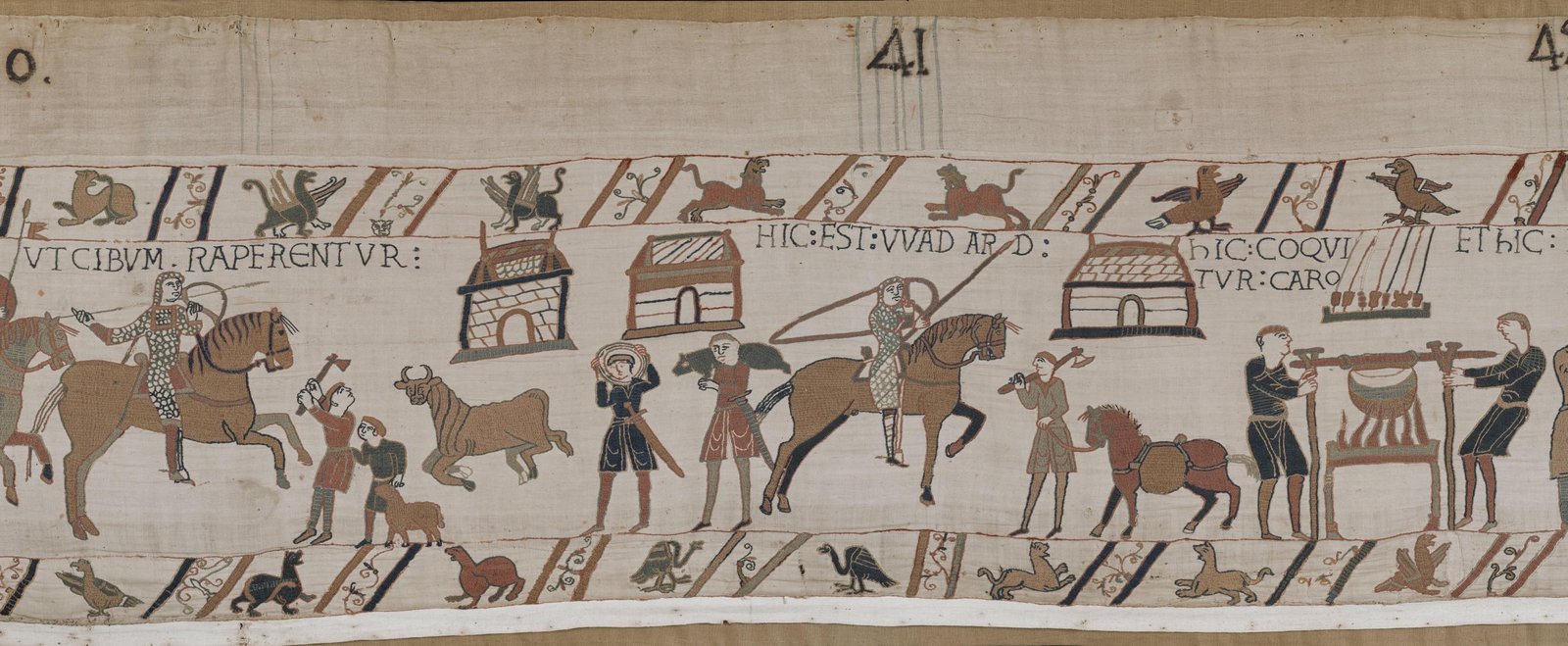
Three comparatively obscure men, Turold, Wadard and Vital, are also named alongside kings and dukes. Wadard and Vital can be connected with Odo's circle through later records, and their appearance has often been used to support an Odo commission. It is an intriguing clue, but naming them does not by itself prove who paid for the work.
The Tapestry also associates Harold's famous oath with Bayeux, Odo's episcopal city, while other accounts place the episode elsewhere. That choice can be read as another clue pointing toward Odo, although it is not conclusive on its own.
If Odo commissioned the tapestry, he likely did so in the 1070s, after the Conquest, when he was at the height of his power as Earl of Kent and one of the richest men in England. He fell from favour in 1082 when William imprisoned him, which gives a plausible end date for the commission.
The Artist Who Left No Name
The tapestry was almost certainly designed by a single artist or a very small team working to a single vision. The narrative structure is too coherent and the visual storytelling too sophisticated to be the work of a committee. The designer was clearly familiar with manuscript illumination, the illustrated books produced in monastic scriptoria. Several motifs in the tapestry, particularly the animals in the borders, closely resemble illustrations found in manuscripts from Canterbury, specifically from the scriptorium of St Augustine's Abbey.
The Canterbury connection is an important part of the case for English manufacture. The design draws on English artistic traditions, the lettering has English features, and the Latin captions include the Old English-derived form ceastra. Border imagery has also been compared with English manuscript traditions. Taken together, these clues point strongly toward an artist or workshop familiar with English visual culture, though they do not identify a single institution or individual.
Some scholars have speculated that the designer was a monk, possibly from Canterbury, working under Odo's direction. A few have suggested that the mysterious "Turold" named in Scene 10 might be the designer leaving a signature, though this is unprovable.
The Hands That Made It
The actual stitching was done by teams of skilled needleworkers. England in the 11th century was famous across Europe for its embroidery, known as Opus Anglicanum (English work), and Anglo-Saxon women in particular were renowned for their needlework skills. The tapestry uses two main stitches, stem stitch for outlines and laid-and-couched work for filling larger areas, both techniques well established in English workshops.
The embroidery was worked in wool, using around ten colours of yarn dyed with plant-based dyes, with eight main shades dominant in the original design: three shades of blue (from woad), two of green, red (from madder), yellow (from weld) and a dark brown or black. The linen ground was made from several strips sewn together lengthwise.
Analysis of the stitching reveals that several different hands worked on the tapestry. Changes in technique and slight variations in the lettering suggest that different sections were produced by different workshops or teams, working simultaneously from a master design. At least one section shows a marked change in the embroidery style, possibly where work was transferred from one team to another.
Whether the embroiderers were men or women is debated. Both sexes practised embroidery in the 11th century, though women's workshops were more common for large-scale textile projects. The traditional assumption is that the tapestry was made by women, possibly nuns, working in a convent workshop, but there is no direct evidence either way.
Written by the British Museum's own curators, this large-format edition reproduces the entire tapestry close enough to see every stitch, with detailed commentary on the embroidery techniques, the artists behind the design, and the subtle clues that point to its English origins. Everything this article raises, examined in full.
Browse Bayeux Tapestry Books →Tracing the Origins
England is the strongest current candidate for the place of manufacture, with Kent and Canterbury often proposed. The manuscript parallels, artistic style, lettering and language all fit an English workshop. Canterbury is especially attractive because of its artistic traditions and Odo's strong connections with Kent, but the evidence does not allow us to name a workshop with certainty.
A Norman place of manufacture has also been proposed. The balance of artistic and technical evidence tends to favour England, but the absence of a surviving workshop record means the question cannot be closed completely.
The 1070s. Probably.
The most widely accepted dating is the 1070s, roughly 1070 to 1077. The lower bound is set by the Conquest itself, since the tapestry obviously post-dates the events it depicts. The upper bound is suggested by Odo's imprisonment in 1082 and by the fact that the tapestry shows no awareness of events after about 1070. The architectural style of the buildings depicted and the military equipment shown are also consistent with the 1070s.
A minority of scholars have argued for a later date, even as late as the 12th century, but the weight of evidence favours a date within a decade of the Conquest, when the events were still in living memory and the political motivations for such a commission were strongest.
What We Will Never Know
For all the detective work, we are left with educated guesses rather than certainties. No contemporary document mentions the tapestry's creation. No contract, no payment record, no letter survives. The tapestry first appears in the historical record in 1476, when it is listed in an inventory of Bayeux Cathedral's treasures. Everything before that is inference.
What is certain is that whoever made it was brilliant. The narrative structure, the visual storytelling, the diplomatic ambiguity of the captions, the subtle character work done through gesture and body language, all of it is the product of an exceptional artistic intelligence. The Bayeux Tapestry is not just a historical document. It is a masterpiece, and its anonymous creators deserve to be ranked among the great artists of the medieval world.
Sources
This article draws on Lucien Musset, The Bayeux Tapestry for the scholarly analysis of the captions and lettering, Gale R. Owen-Crocker for the embroidery techniques and scribal hands, David M. Wilson for general commentary, and the Domesday Book for the identification of Odo's tenants.