A medieval masterpiece, a historical record, and one of the most remarkable surviving artefacts from the Middle Ages
Despite its name, the Bayeux Tapestry is not technically a tapestry at all. It is an embroidery. In a tapestry, the design is woven into the fabric as it is made; in an embroidery, the design is stitched onto an existing cloth. The Bayeux Tapestry was made by stitching coloured wool onto linen, using stem stitch for outlines and laid-and-couched work for larger areas. The familiar name has simply endured.
The Bayeux Tapestry measures approximately 70 metres (230 feet) in length and about 50 centimetres (20 inches) in height. To put that in perspective, it is roughly the length of two tennis courts laid end to end, or about three-quarters the length of a football pitch. The tapestry was originally even longer, scholars believe several metres are now missing from the end, which would have shown William's coronation as King of England on Christmas Day 1066.
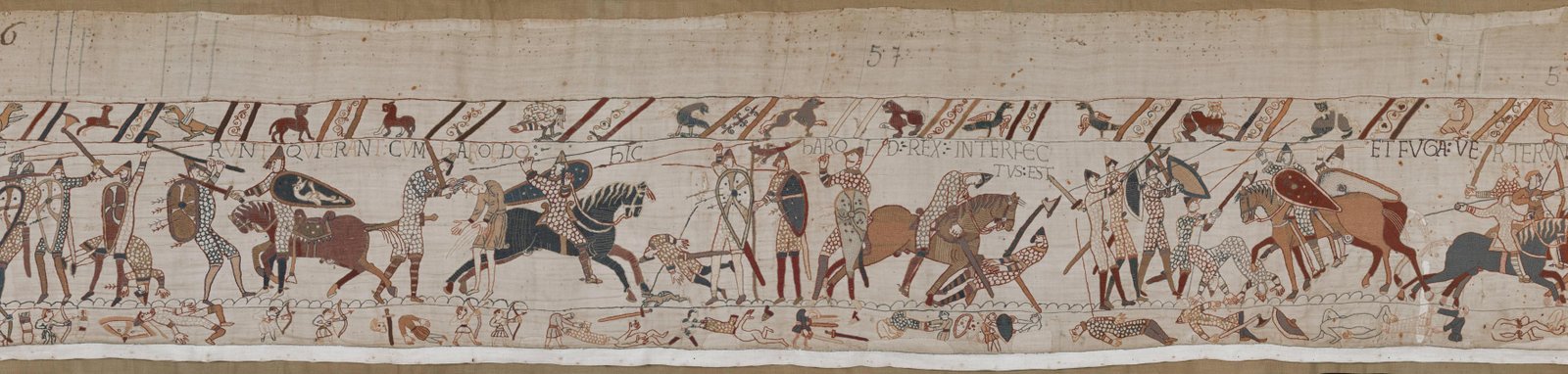
The embroidery tells the story of the events leading to the Norman Conquest of England in 1066. It opens with Edward the Confessor and Harold Godwinson in discussion before Harold travels across the Channel. The inscription does not tell us why he goes. Harold is shipwrecked, captured, and eventually brought to Duke William. In a pivotal scene he swears an oath, but the Tapestry never states exactly what he promised. After Edward dies in January 1066, Harold is shown enthroned as King. The story then moves through Halley's Comet, William's invasion preparations, the Channel crossing and the Battle of Hastings on 14 October 1066, where Harold is killed and the English army is defeated.
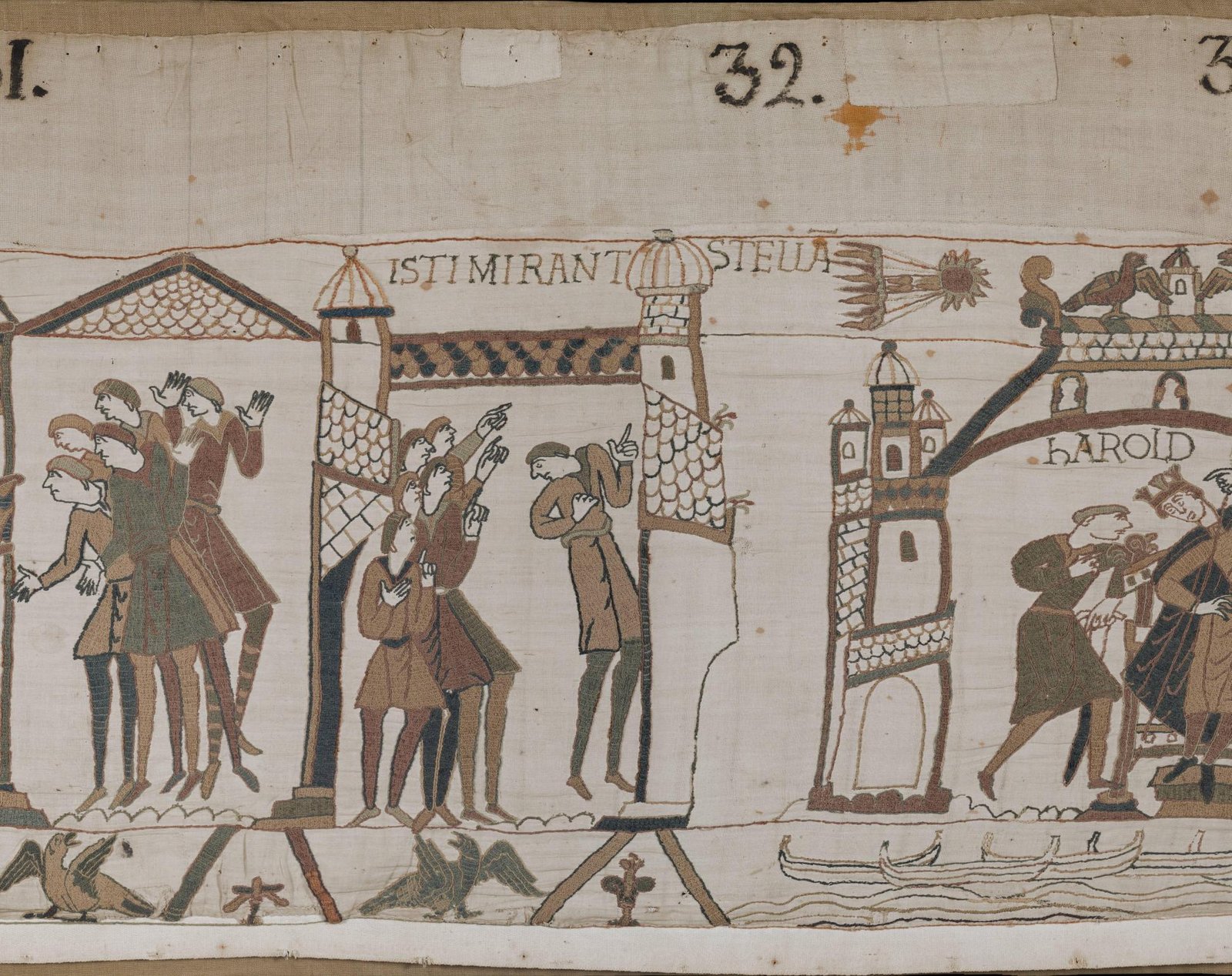
The embroidery was made after the Norman victory, but it does not explain every event or condemn Harold at every turn. Some of its most important moments, including Harold's journey and oath, remain deliberately or frustratingly ambiguous.
Nobody signed the Bayeux Tapestry, and nearly a thousand years later we still do not know exactly who commissioned, designed or stitched it. Bishop Odo of Bayeux is one of the leading candidates for patronage, but there is no surviving document proving the commission. The strongest evidence points to manufacture in England, and Canterbury is an important possibility because of the artistic and manuscript connections. The embroiderers themselves remain anonymous, and we cannot say with certainty whether they were men, women, or a mixture of both.
The definitive large-format companion to the British Museum exhibition, written by the museum's own curators. It reproduces the entire tapestry in extraordinary detail — close enough to see every stitch — with scene-by-scene commentary covering exactly the questions this article raises about the embroiderers, the borders, and the hidden details most visitors miss.
Browse Bayeux Tapestry Books →The Tapestry is commonly dated to the later 11th century, with the 1070s often proposed. That places it close enough to the Conquest to make it an unusually early visual source for the events of 1066. It clearly reflects a world shaped by the Norman victory, and it may have served political as well as commemorative purposes. But describing it simply as propaganda risks flattening a work that often treats its English figures, especially Harold, with more complexity than that label suggests.
The Bayeux Tapestry was embroidered on linen using woollen thread in around ten colours, with eight main shades dominant in the original design. Those colours are not bright or flashy, they are warm and earthy: reds and terracottas, several shades of blue, greens ranging from olive to sage, a dull gold, and a very dark blue that is almost black. What makes them remarkable is how the embroiderers used them. Horses appear in blue and red as well as brown. Colours were chosen to make the scenes vivid and easy to follow, not to copy nature exactly.
The threads were stitched onto linen cloth using two main techniques: stem stitch for outlines and fine details, and a broader filling stitch for larger areas. The linen was made from several strips sewn together, and the designs were almost certainly drawn directly onto the cloth before stitching began. Over the centuries, repairs have introduced some additional colours including lighter yellows, brighter greens, and orange, which sit slightly differently from the original shades. The borders running above and below the main story are filled with animals, scenes from Aesop's fables, and glimpses of everyday life alongside the brutal realities of war.
The tapestry as it survives today ends abruptly with the English in flight after the Battle of Hastings. Scholars believe the final section, which would have shown William's coronation on Christmas Day 1066, is now lost. Whether it was deliberately removed, destroyed, or simply deteriorated over time is unknown. Some early descriptions of the tapestry mention scenes that are no longer present, suggesting that the ending was intact as recently as the 18th century.
The fact that the Bayeux Tapestry has survived for nearly a thousand years is remarkable. It has endured wars, revolutions and the ordinary dangers faced by a fragile textile. During the French Revolution it narrowly escaped being used as a wagon covering, and during the Second World War it was moved repeatedly for protection. Normally displayed in Bayeux, Normandy, it is now the focus of the British Museum's 2026-27 exhibition in London, an extraordinary opportunity to see the original embroidery in Britain.
Try our free Bayeux Tapestry logic puzzle, a kids' mystery and a grown-up detective challenge, both built around real facts from the tapestry.
Once you know what the Bayeux Tapestry is, the best way to understand it is to follow its story, its makers and its survival.
Follow the complete visual story from Edward and Harold to the aftermath of Hastings.
Open the scene guide →Look at the evidence for English manufacture, Canterbury and the possible patron.
Investigate its origins →Prepare for the British Museum exhibition and make the most of your viewing time.
Plan your visit →Follow the extraordinary story of the embroidery across nearly a thousand years.
Read the survival story →