The Story You've Always Heard
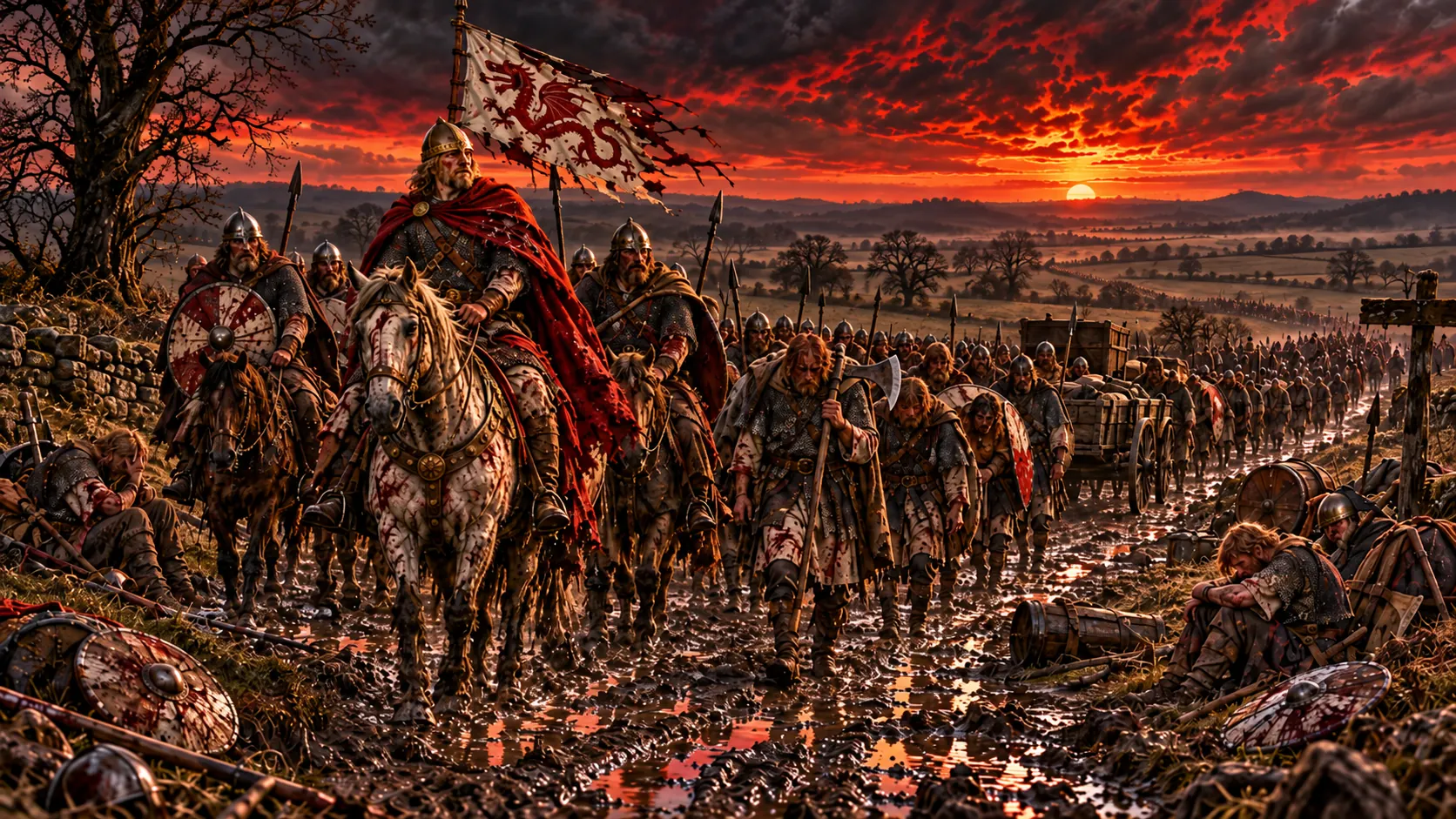
It's one of the most repeated details in the whole story of 1066. On 25 September, Harold Godwinson destroyed a Norwegian invasion at Stamford Bridge, near York. Three days later, William's fleet landed on the Sussex coast. Harold, so the familiar story goes, turned his battered army around and marched south at extraordinary speed, with exhausted men covering close to 200 miles before fighting another major battle on 14 October.
That image has shaped how Hastings is often explained. Harold's defeat is sometimes attributed in part to exhaustion: one army had crossed the country after a major battle, while the other had landed, prepared and waited.
The central question
No one disputes that Harold moved rapidly from the north back towards London and then Sussex. The argument is over how much of that journey was made on foot, who travelled with him, and whether the whole English army endured one continuous forced march.
A Theory That Challenges the Traditional Picture
Research by Professor Tom Licence argues that the famous forced-march story may be too simple, and that the familiar version owes more to later historical reconstruction than to a clear statement in the medieval sources.
The case begins with what the sources do not say. The Anglo-Saxon Chronicle and other near-contemporary accounts do not describe Harold's entire army marching the full distance from Yorkshire to Sussex on foot in one unbroken effort. The highly specific image of a punishing 200-mile forced march became especially influential through later historians, including Edward Augustus Freeman in the 19th century.
Licence also raises a practical question. The pace required by the traditional version would have been demanding even for experienced armies with good organisation and supply. That does not make it impossible, but it gives historians reason to look carefully at whether the evidence actually requires such a journey.
The Case for Harold's Fleet
The most striking part of the argument concerns Harold's navy. The Anglo-Saxon Chronicle records Harold travelling by ship after the English fleet was withdrawn from the south coast in September, showing that naval transport remained part of the campaign.
Licence also draws attention to the Chronicle's use of the Old English word lið in describing forces connected with Harold's northern campaign. The interpretation of such terms can be debated, but the broader argument is that naval forces may have remained more important to Harold's strategy than the familiar land-march story suggests.
If that is right, the journey south need not have been a single exhausted column trudging the entire length of England. Harold's movements may have combined rapid overland travel, ships and separate troop movements, giving at least some of his forces more rest than the traditional account allows.
What this theory does not prove
It does not prove that Harold's whole army sailed south, or that exhaustion played no part at Hastings. It challenges the assumption that one complete English army marched roughly 200 miles on foot as a single force immediately before the battle.
A Possible Land-and-Sea Strategy
The research goes further by reconsidering reports of English ships moving south after William's landing. One possibility is that Harold intended to use both land and naval forces against the Norman position, with his army advancing towards Hastings while ships threatened William's communications and retreat by sea.
Under this interpretation, the English response was not simply a desperate rush south. It may have been a coordinated attempt to contain the Norman invasion using the same combination of land and sea power that had helped Harold defend the kingdom earlier in the year.
The theory also offers a possible context for difficult evidence relating to naval activity in early October 1066, including material later recorded in Domesday Book and the Annales Altahenses. This evidence is suggestive rather than decisive, but it becomes more interesting if Harold's fleet remained operational during the Hastings campaign.
Why It Matters
None of this changes the outcome. Harold died at Hastings and William became king. What changes is the picture of the English campaign before the battle.
If the conventional forced-march story is overstated, Harold looks less like a commander simply racing from crisis to crisis and more like a king attempting to coordinate land and sea forces against two invasions in the space of a few weeks.
That does not automatically make every part of the newer theory correct. It does, however, show why familiar stories about 1066 still need to be tested against the medieval evidence rather than repeated simply because they have become traditional.
What Can We Reasonably Say?
The safest conclusion
Harold certainly moved rapidly south after Stamford Bridge. What remains uncertain is whether the traditional picture of his whole army enduring a single 200-mile forced march on foot is accurate.
The surviving evidence leaves room for a more complicated campaign involving separate troop movements and continued use of naval forces.
Follow Harold, William and the events leading to Hastings through all 58 scenes of the Bayeux Tapestry, with the evidence and uncertainties explained in plain English.
View the Book on Amazon →As an Amazon Associate I earn from qualifying purchases.
Sources
This article draws on Tom Licence's research, presented at the University of Oxford, and on the Anglo-Saxon Chronicle for the primary medieval account of the campaign.