January
5 January. Edward the Confessor, King of England, dies at Westminster after a long illness. He is buried the next morning in the abbey he spent decades building, just days after its consecration. The question of who should succeed him has no simple answer. Edward had no children.
6 January. Harold Godwinson, Earl of Wessex and the most powerful nobleman in England, is enthroned as King at Westminster. The succession follows Edward's death with striking speed. The Witan accepts Harold, but he is not the only man with a claim. Across the Channel, Duke William of Normandy maintains that Edward had promised him the throne. In Scandinavia, King Harald Hardrada of Norway also has a claim.
Spring
Harold spends the early months of his reign preparing for trouble. He knows William is gathering forces in Normandy and that an invasion fleet is being built. Harold musters the English fleet along the south coast and positions his army to defend against a Channel crossing. It is the largest military mobilisation England has seen in living memory.
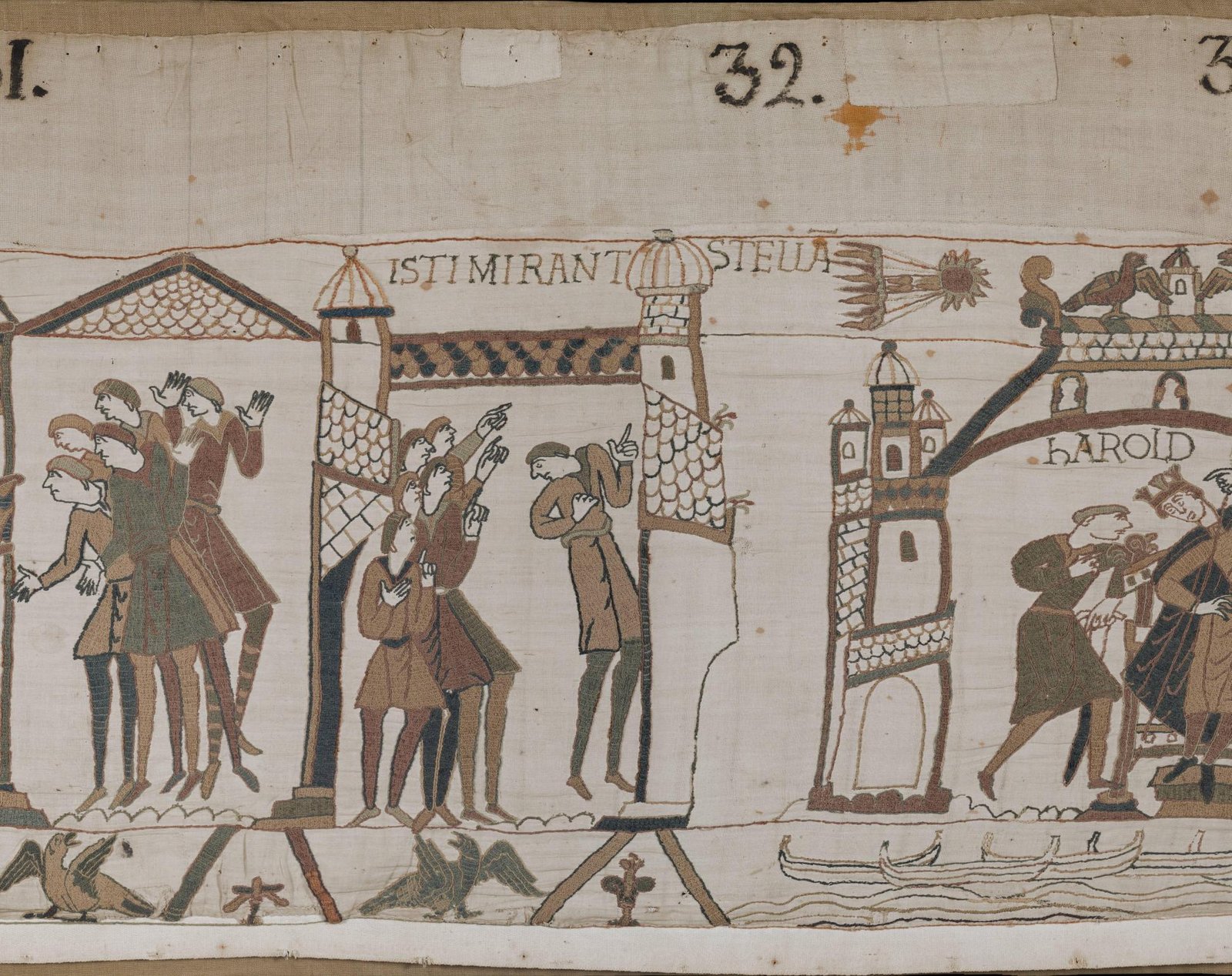
Late April. Halley's Comet appears in the sky and is visible for several nights. Medieval observers often treated unusual celestial events as omens, and the Tapestry gives the comet a prominent place in the story. The embroidery shows figures pointing upward while Harold sits nearby, but it does not tell us exactly how every viewer was expected to interpret the sign.
Use the dates carefully
Some events in 1066 can be dated precisely, while others are reconstructed from chronicles written from different viewpoints. The timeline keeps firm dates where the evidence is strong and avoids pretending that every movement can be pinned down to the day.
Summer
The summer of 1066 is a long, tense wait. Harold holds his fleet and army on the south coast through June, July and August, watching for William's sails. The problem is that medieval armies cannot be held together indefinitely. The men are farmers and landholders with harvests to bring in, and the fleet's supplies are running low.
8 September. With no sign of William and the campaigning season stretching on, Harold stands down much of the force guarding the south coast. Men return home and the fleet disperses. The decision leaves England less ready just as the northern crisis is about to begin.
September
Mid-September. Harald Hardrada of Norway, allied with Harold's own exiled brother Tostig, sails up the Humber with a fleet of around 300 ships and lands in Yorkshire. The northern earls Edwin and Morcar march to meet him.
20 September. The Battle of Fulford Gate. Hardrada and Tostig crush the northern English army outside York. The city submits and agrees to provide hostages. Hardrada camps at Stamford Bridge, east of York, to await the hostages and collect provisions. He believes the campaign is won.
25 September. Harold reaches Stamford Bridge after a remarkably rapid march north. The Norwegian force is caught by surprise and many of its men are not fully equipped for battle. Hardrada is killed, Tostig also dies, and the invasion force suffers a crushing defeat. Later tradition records that only a small fraction of the ships that had brought the army were needed to carry the survivors home.
27 September. Two days after Stamford Bridge, the wind in the Channel changes. William's invasion fleet, which has been waiting at Saint-Valery-sur-Somme for weeks, finally sets sail.
28 September. William lands at Pevensey on the Sussex coast. There is no opposition. Harold's fleet has been stood down. His army is 250 miles away in Yorkshire, battered from Stamford Bridge. William builds a fort, begins ravaging the countryside, and waits.
October
Harold receives news of William's landing while still in the north. He immediately turns his exhausted army around and marches south at extraordinary speed, covering the distance in under a fortnight. He arrives in London around 6 October and pauses briefly to gather reinforcements, though many of his best troops are still straggling south from Yorkshire.
13 October. Harold marches out of London and takes up position on Senlac Ridge, about seven miles north of Hastings, blocking the road to London. He arrives in the evening and deploys his army along the ridge in a dense shield wall.
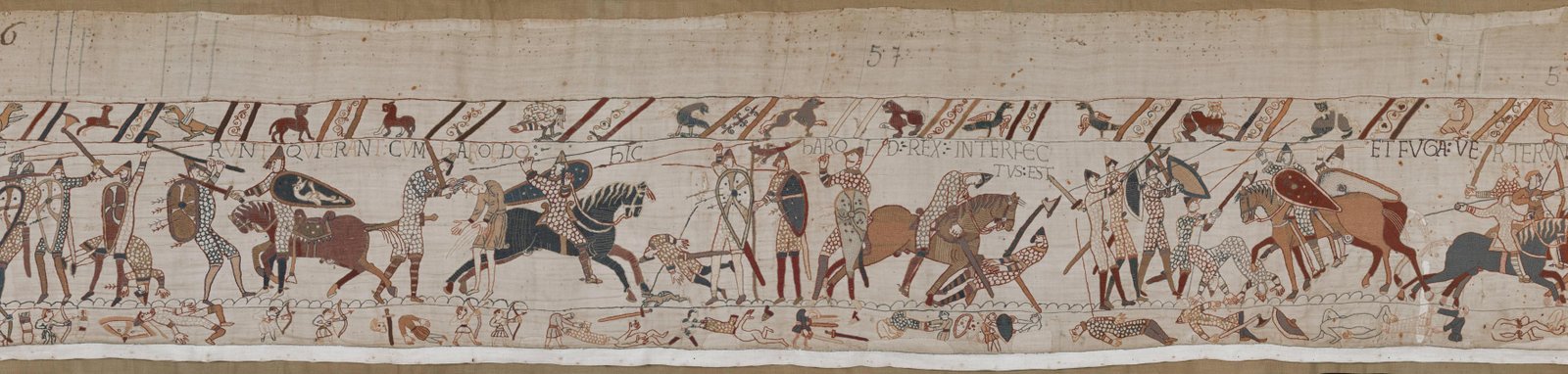
14 October. The Battle of Hastings. The battle begins in the morning and lasts for much of the day. William attacks uphill with archers, infantry and cavalry, while the English fight behind a shield wall on the ridge. At one point a rumour spreads that William has been killed, and he shows himself to his troops to restore order. As the fighting continues the English line is gradually weakened. Harold's brothers Leofwine and Gyrth are killed, and Harold himself dies late in the battle. The exact manner of his death remains disputed. The Tapestry shows a figure with an arrow in or near his eye and another being struck down by a mounted knight beneath the death inscription. With Harold dead, organised English resistance collapses.
A sharp and forensically argued book that takes the familiar story of 14 October 1066 apart and reassembles it from the ground up. Ian Pusey examines the landscape, the sources, and the decisions that shaped the outcome, asking whether the standard account of the battle holds up to scrutiny. Essential reading for anyone who has just worked through this timeline and wants to go further.
Explore Battle of Hastings Books →November and December
William does not march directly on London. He sweeps through Kent, takes Dover, then circles around London, crossing the Thames at Wallingford and approaching the city from the north-west. The English leadership, already fractured, collapses. Edgar the Aetheling, the last male of the royal house, is briefly proclaimed king but never crowned. The leading English nobles and churchmen submit to William at Berkhamsted.
25 December 1066. William is crowned King of England in Westminster Abbey on Christmas Day. During the ceremony, the shouts of acclamation from inside the abbey are misheard by the Norman guards outside, who think a riot has broken out. They set fire to surrounding buildings. The congregation panics. William, according to one account, is left trembling at the altar. It is a fitting end to the most violent and chaotic year in English history.
The Aftermath
The Conquest was not completed in a single year. English resistance continued for years, particularly in the north, where William's response, the Harrying of the North in 1069-70, devastated Yorkshire so thoroughly that the Domesday Book, compiled twenty years later, still records vast areas as waste. But 1066 itself, a single year containing three pitched battles, two foreign invasions, three kings and the end of Anglo-Saxon England, remains the most consequential twelve months in English history. Every English monarch since has descended from William. The language, the law, the architecture, the very idea of what England is, all trace back to this year.
Sources
This article draws primarily on the Anglo-Saxon Chronicle for the English perspective, William of Poitiers for the Norman account, and David C. Douglas, William the Conqueror for the modern scholarly framework. Scene descriptions reference the Bayeux Tapestry Museum materials.